5 Efficient C Programming
5.7 Structure Alignment
구조체의 entry 정렬 여부는, 메모리 크기 및 효율성에 큰 영향을 미친다.
- 컴파일러는 구조체의 start address를, 'entry에서 가장 큰 데이터 타입의 배수'로 정렬한다.
따라서, 일반적으로 4 bytes 혹은 8 bytes로 정렬된다.
- 남는 메모리 공간에는 padding이 적용된다.
5.7.1 Reordering Structure Members
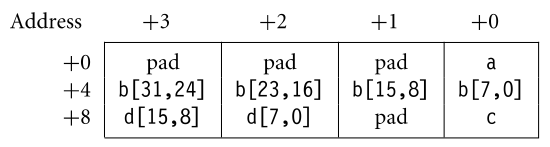
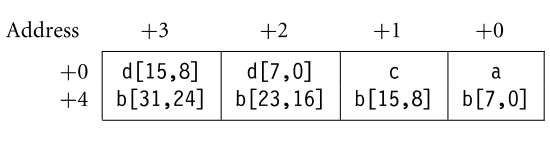
다음 예시는 다양한 데이터 타입으로 구성된 구조체를 갖는 메모리 공간이다.
-
Example 1: entry 중
int(4 bytes)가 제일 크므로, start address는 4의 배수를 갖는다. (12 bytes) -
Example 2: 크기가 작은 데이터 타입부터 정렬하는 것으로 메모리 공간을 확보할 수 있다. (12 8 bytes)
| Example 1 |
|
 |
|
Example 2 (Reordered) |
|
 |
5.7.2 Removing Padding
__packed 키워드를 사용하여, armcc 컴파일러가 구조체 내부에 padding을 적용하지 않도록 지시할 수 있다.
|
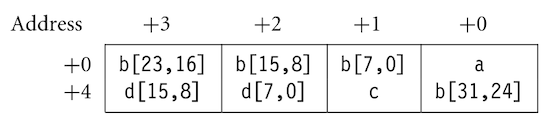 |
하지만 이러한 구현은 데이터 접근에서 shift와 같이 추가적인 명령어를 필요로 하므로 비효율적이다.
5.7.3 Inserting Padding
메모리 사용량을 제외한 성능 면에서는 명시적으로 padding을 삽입하는 것이 바람직하다. 다음은 명시적으로 padding을 삽입한 구조체 예시다.
struct {
  char a;
  char padding1[3];
  int b;
  char c;
  char padding2[1];
  short d;
  ...
}
별개로 `enum` 구조체 타입은, 컴파일러마다 데이터 크기를 다르게 취급하므로 주의해야 한다. - 예를 들어 armcc는 `bool` 타입을 1-byte로 취급하지만, gcc는 4-byte로 처리한다.typedef enum { FALSE, TRUE } Bool;
5.8 Unaligned Data and Endianness
정렬되지 않은 데이터와 Endian은 메모리 접근과 이식성(portability)에 영향을 미치므로 주의해야 한다. 특히 ARM의 load/store 명령어는, 메모리의 시작 주소가 데이터 타입의 정수 배임을 가정한다.
반면, 데이터 접근은 unaligned data를 대상으로도 가능하다.
- 컴파일러에게
__packed지시자를 통해, 데이터가 임의로 정렬되어 있음(4의 배수가 아닐 수 있음)을 알릴 수 있다.
단, 성능 면에서
__packed보다는char *를 사용하는 편이 더 효율적이다.
| C Code | Assembly |
|
|
5.8.1 Endianness
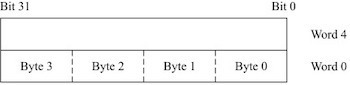
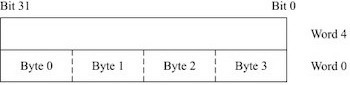
ARM은 little-endian, big-endian을 모두 지원한다.
| little endian | big endian |
|
|
|  |  |
5.9 Division
ARM은 나눗셈 명령을 하드웨어 수준에서 제공하지 않으며, 대신 컴파일러에서 C 라이브러리 루틴으로 제공한다.
- 하지만 표준 정수 나눗셈 루틴이 20~100 cycle을 소모할 만큼 비싼 연산이므로 가급적 피해야 한다.
implementation, early termination, input operands의 range 등 여러 요인에 따라 #cycle은 달라진다.
다음과 같이 간단한 나눗셈 코드는 덧셈/뺄셈 명령으로 연산을 대체할 수 있다.
circular buffer를 위한 코드로,
increment<buffer_size를 가정한다.
| C Code(약 50 cycle) | C Code(3 cycle) |
|
|
만약 나눗셈을 피할 수 없다면, 분자와 분모의 데이터 타입으로 unsigned int를 사용하는 편이 낫다.
signed division 루틴: 분자와 분모에 절댓값을 취한 뒤, unsigned 나눗셈 루틴을 호출하는 방식 (이후 결과의 부호를 수정)
5.9.1 Using Modulus, Remainder to Avoid Division
많은 C 라이브러리 루틴은 몫과 함께 나머지도 반환한다. 다음은 screen buffer에서 offset byte 만큼 떨어진 위치 좌표 (x, y)를 찾는 코드다.
| C code | Assembly |
|
|
앞서 p.x를 나눗셈이 아닌 뺄셈과 곱셈으로 획득하므로 언뜻 효율적으로 보이지만, 나눗셈 루틴에서 반환하는 몫과 나머지를 함께 활용하면 더 효율적이다.
-
C 라이브러리의 나눗셈 루틴은(
__rt_udiv) 몫과 나머지는 함께 획득할 수 있다. -
getxy_v1()함수에 비해 4개 명령어가 덜 필요하다.
| C code | Assembly |
|
|
5.10 Inline Functions and Inline Assembly
#define으로 함수 매크로를 정의할 수 있지만, 매크로보다는 #inline을 통한 inline function 구현이 효율적이다.
매크로는 preprocessor에 의해 코드에 삽입되며, 함수의 인자와 반환 타입을 체크하지 않는다.
다음은 C 코드로 작성한 함수 매크로 예시다.#define CALC_MAX(a,b) // 매크로 함수는 대체로 대문자 { if(a>b) c=a; else c=b; } int main(void): { inc c, ... CALC_MAX(a,b); }
5.10.1 Inline Functions
다음은 16-bit 입력을 받아서 32-bit 출력을 계산하는, saturating doubling multiply-accumulate를 구현한 코드이다. (speech processing에서 종종 사용된다.)
-
sat_correlate(): 계산 -
: 16-bit signed operands(
short) : 32-bit signed accumulator(int)
int sat_correlate(short *x, short *y, unsigned int N)
{
  int a=0;

  do
  {
    a = qmac(a, *(x++), *(y++));
  } while (--N);
  return a;
}
위 코드에서 를 계산하는 qmac() 함수는 내부적으로 inline 처리된다. (함수 호출 overhead 감소)
-
qmac(): 를 계산한다. -
이때 32-bit 범위를 초과하면, nearest possible value으로 saturate된다.
__inline int qmac(int a, int x, int y)
{
  int i;
  i = x*y; /* this multiplication cannot saturate */
  if (i>=0)
  {
    /* x*y is positive */
    i = 2*i;
    if (i<0)
    {
      /* the doubling saturated */
      i = 0x7FFFFFFF;
    }
    if (a + i < a)
    {
      /* the addition saturated */
      return 0x7FFFFFFF;
    }
    return a + i;
  }
  if (a + 2*i > a)
  {
    /* the accumulate saturated */
    return - 0x80000000;
  }
  return a + 2*i;
}
참고로
x,y를 Q15 fixed-point integers로 취급하는데, 이유는 각자 , 값을 표현하기 때문이다.비슷하게
a는 Q31 fixed-point integer로, 값을 표현한다.
5.10.2 Inline Assembly
C 컴파일러의 inline assembly를 활용하면, 보다 넓은 영역까지 코드를 최적화할 수 있다.
-
__asm지시자를 사용하여 C 코드에 어셈블리 코드를 작성할 수 있다. -
C 코드에서 선언한 변수도 그대로 사용할 수 있다.
다음은 qmac() 함수의 비효율적인 if 조건문을, inline assembly로 최적화한 코드다. (ARMv5E 확장 명령어 활용)
SMULBB{<cond>}{S} Rd, Rm, Rn: 두 signed 16-bit 값을 곱한다. (레지스터의 bottom half를 취해서 곱)
QDADD{<cond>}{S} Rd, Rm, Rn: SAT(Rm+ SAT(Rn* 2))를 수행한다.
| C Code(+Inline Assembly) | Assembly |
|
|
다음은 Coprocessor 15의 instruction cache를 flush하는 코드다. (비슷한 방식으로 다른 Coprocessor도 접근할 수 있다.)
void flush_Icache(void)
{
  #ifdef __ARMCC_VERSION /* armcc 버전 */
    __asm {MCR p15, 0, 0, c7, c5, 0}
  #endif
  #ifdef __GNUC__        /* gcc 버전 */
    __asm("MCR p15, 0, 0, c7, c5, 0");
  #endif
}