13 LLM Deployment Techniques
EfficientML.ai Lecture 13 - LLM Deployment Techniques (MIT 6.5940, Fall 2024)
13.4 TinyChat: Mapping AWQ onto Edge Platforms
AWQ: Activation-aware Weight Quantization for LLM Compression and Acceleration 논문(2023)
AWQ 논문에서는 W4A16 양자화 모델 추론에 최적화한 시스템 프레임워크 TinyChat을 제안하였다. 다음은 TinyChat이 강조하는 주요 특징이다.
-
efficient, lightweight, Python-native
-
multi-platform (cloud, desktop/laptop, edge GPUs, mobile CPUs)
13.4.1 Hardware-aware Weight Packing
Notes: 메모리에서 값은 byte-aligned로 저장(
1 byte=8 bit)되므로, 4 bit 가중치를 효율적으로 활용하기 위해선 별도의 시스템 설계가 필요하다.
다음은 (128-bit SIMD unit을 지원하는 ARM NEON 아키텍처를 고려한) TinyChat의 weight packing 과정을 나타낸 그림이다. (ARM NEON에서 1.2x speedup 달성)
(1) 순서를 재배치한 후 1 byte마다 가중치를 한 쌍씩 패킹한다. (Offline)
(2) 128-bit SIMD 레지스터에 32개 가중치를 적재한다. (Runtime)
(3) 32개 가중치를 unpacking한다. (Runtime, SIMD 명령어 3개로 구현)

SIMD 레지스터일 때, 언패킹 이후 각 레지스터에서 개의 가중치를 담게 된다.
13.4.2 Kernel Fusion
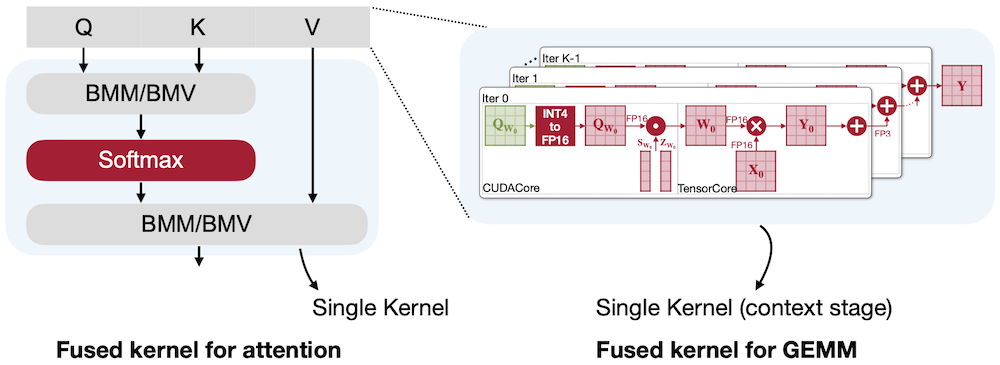
TinyChat에서는 intermediate DRAM access와 kernel launch overhead를 줄이기 위해, 최적화 기법으로 kernel fusion을 도입하였다. 다음은 여러 operator를 단일 kernel로 결합한 예시이다.
-
Layer Normalization:
multiplication,division,square root등을 단일 kernel로 결합 -
Attention Layer:
QKV projection을 단일 kernel로 결합하고, PE 계산을 on-the-fly로 수행
13.4.3 TinyChat Benchmark
다음은 TinyChat(W4A16)과 Huggingface(FP16) 추론 성능을 비교한 벤치마크 결과이다. 해당 실험에서 TinyChat은 Huggingface 대비 최대 3.9x 속도를 달성하였다.
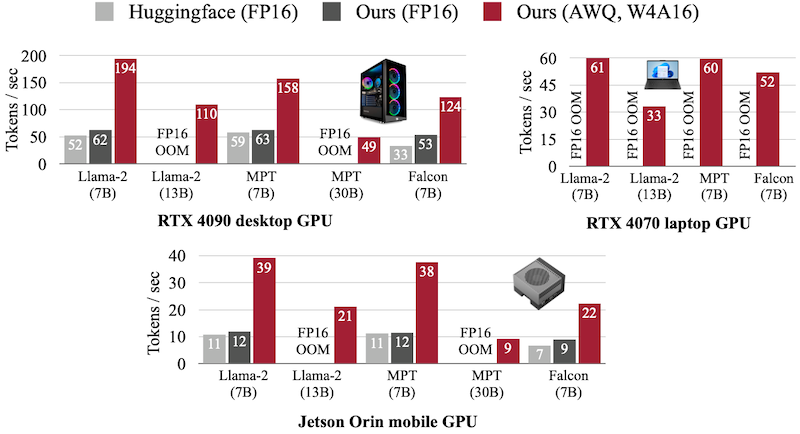
desktop(RTX 4090), laptop(RTX 4070), mobile GPU(Jetson Orin)
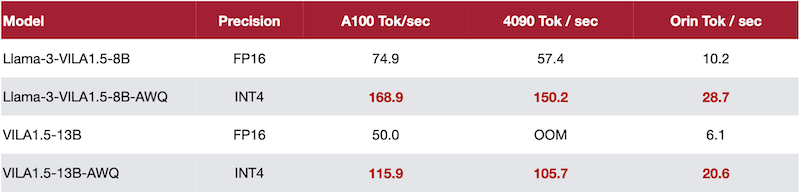
추가로 TinyChat에서는 VLM 모델인 VILA 추론도 지원한다.
13.5 Inconsistency between Cloud and Edge
앞서 AWQ는 배치 사이즈가 작은 edge LLM inference 시나리오에서 가속에 성공했지만, 거대한 배치 사이즈의 cloud LLM inference 시나리오에서는 성능을 향상하지 못한다.
또한 살펴본 edge serving(W4-A16-KV16)과 달리, cloud serving에서는 보편적으로 W8-A8-KV8 양자화를 적용한다.
| Weights | Activations | KV caches | |
|---|---|---|---|
| Edge | 4-bit per-group |
keeps FP16 |
keeps FP16 |
| Cloud | 8-bit per-channel |
8-bit per-token |
8-bit per-tensor |
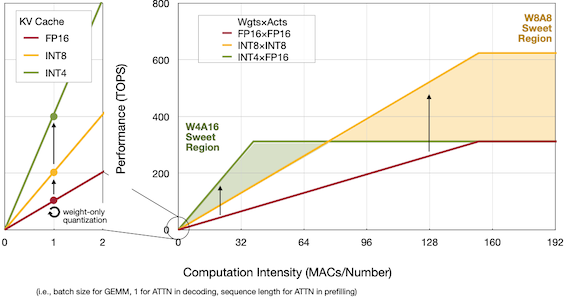
다음은 배치 사이즈에 따른 computation intensity를 양자화 설정별로 비교한 그림이다.
| Edge(AWQ) | Cloud(SmoothQuant, QServe) |
|---|---|
 |
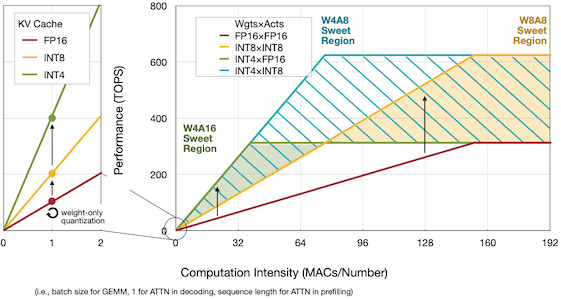 |
빨간색:
FP16, 주황색:W8-A8-KV8(SmoothQuant), 초록색:W4-A16-KV16(AWQ), 파란색:W4-A8-KV4(QServe)
13.5.1 Current Status of LLM Serving Systems
다음은 cloud serving을 위한 다양한 추론 엔진을, 여러 양자화 설정(Llama-2-7B 모델)에서 비교한 결과를 나타낸 그림이다.
W8A8보다 bit precision을 낮추더라도, kernel overhead에 의해 W8A8보다 낮은 성능만을 달성하였다.
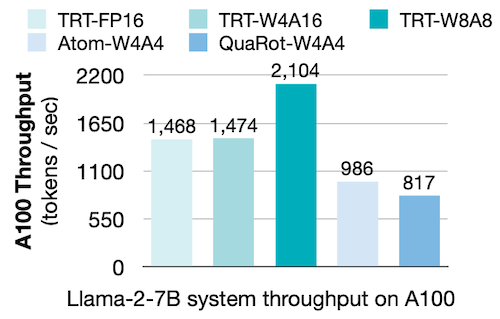
TRT: TensorRT-LLM
이때 INT4 양자화에서 발생하는 대표적인 dequantization overhead는 다음과 같다. (참고로 대부분의 W4A4에서는 성능을 고려해 per-group quantization을 사용한다.)
-
W4A16:FP16tensor core로 수행하는 GEMM 연산 -
W4A4: scaling factor(FP16)의 partial sum
13.5.2 Overhead in Quantized GEMM on GPUs
CUDACore operation:
INT4TensorCore의 50배 비용이 든다. (e.g., A100)
다음은 대표적인 Quantized GEMM 커널의 구현을 나타낸 그림이다. (구분: 빨간색(FP16), 주황색(INT8), 초록색(INT4))
-
(a): main loop에서 오로지 tensor core operation만 수행한다. (= hardware efficient)
-
(b), (c): main loop에서 partial sum, weight dequantization overhead를 갖는다.
(a) TensorRT-LLM (W8A8)
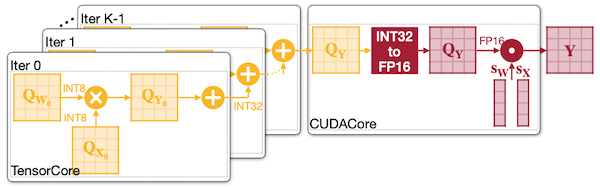
모든 dequantization operation은 가장 마지막에 수행된다.
(b) TensorRT-LLM (W4A16)
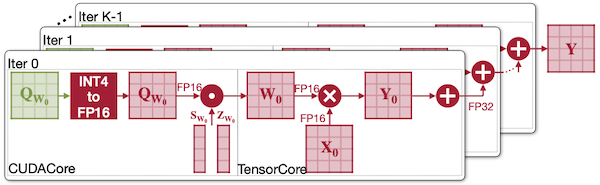
INT4 to FP16 dequantization이 input conversion 방식으로 매번 수행된다.
(c) ATOM (W4A4)
Notes:
INT4TensorCore는INT32partial sum을 반환한다.
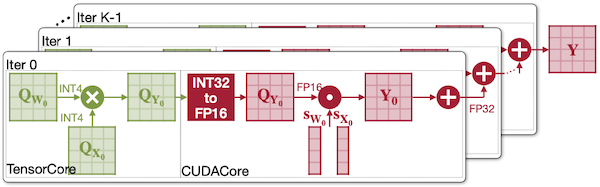
main loop에서 CUDACore operation이 차지하는 비중이 크며, GEMM에서 partial sum을 수행하기 위해 (input conversion 대비) 더 많은 레지스터와 연산을 필요로 한다.
13.6 QServe
QServe: W4A8KV4 Quantization and System Co-design for Efficient LLM Serving 논문(2024)
QServe는 AWQ와 SmoothQuant의 장점을 동시에 취하기 위한 W4-A8-KV4 양자화 알고리즘 QoQ와, 이에 최적화된 시스템 설계를 함께 제안하였다.
(d) QServe (W4A8)
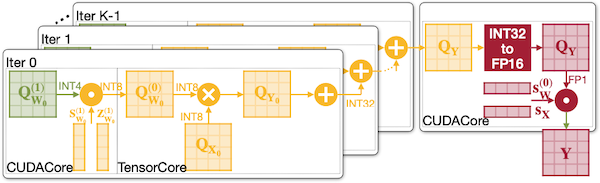
INT4 가중치를 INT8로 변환한 뒤, 모든 행렬 연산을 INT8로 수행한다. 이후 main loop를 벗어난 가장 마지막에 partial sum을 수행한다.
13.6.1 QoQ Algorithm: SmoothAttention
QoQ(Quattuor-Octo-Quattuor): 4-8-4 in Latin
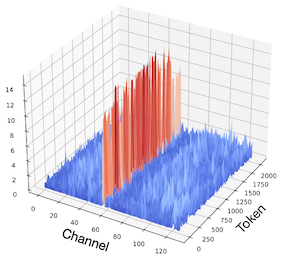
QServe는 4-bit KV 양자화에서 발생하는 정확도 하락을 방지할 수 있는 SmoothAttention 기법을 제안하였다.
-
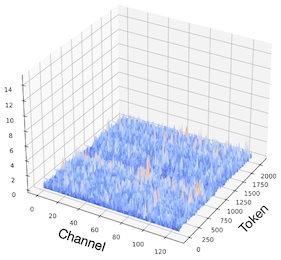
Value: 유의미한 outlier 패턴을 보이지 않는다.
-
Key: 각 head마다 fixed outlier channel을 갖는 경향이 보인다.
| Layer 24 Values | Layer 24 Post-RoPE Keys (Original) |
Layer 24 Post-RoPE Keys (SmoothAttention) |
|---|---|---|
 |
 |
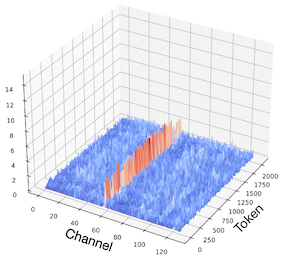 |
따라서 SmoothAttention에서는, Key 행렬의 outlier를 smoothing하는 방식으로 성능 저하를 방지한다. (SmoothQuant와 유사)
,
13.6.2 Dequantization with Reg-Level Parallelism
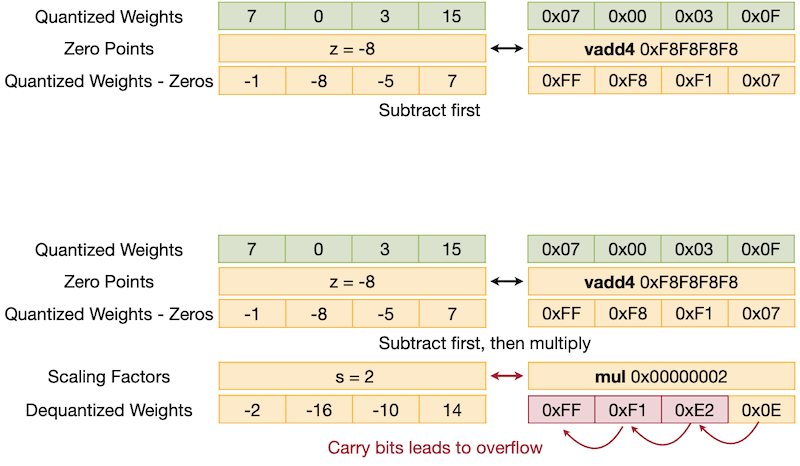
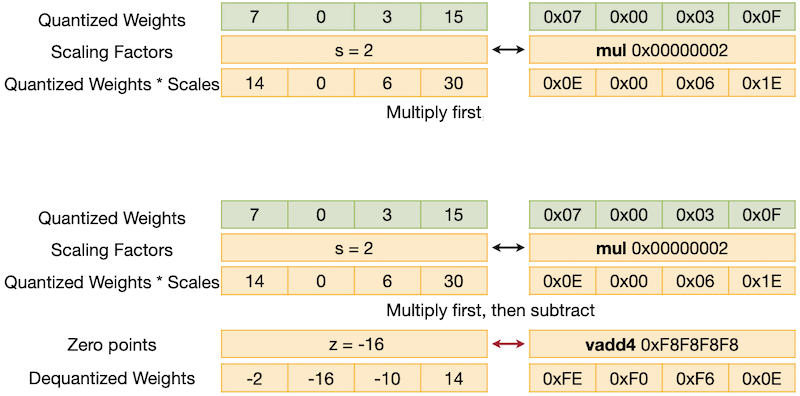
QServe에서는 UINT4의 dequantization을 UNIT4 UINT8 SINT8 순서로 수행한다. (register-level parallelism 활용)
UNIT4UINT8: TinyChat과 유사,UINT8SINT8: apply zeros, scales
하지만 이때, dequantization을 subtract-multiply 순서(zero point를 뺀 후, scale)로 구현할 경우, 다음과 같이 carry bits에 의한 overflow가 발생할 수 있다.
반면, multiply-subtract 순서로 구현하면 carry bits에 의한 overflow를 방지할 수 있다.
13.6.3 QServe Benchmark
다음은 WikiText2 perplexity를 기준으로 한 비교에서, QServe는 기존 시스템의 성능을 제치고 SOTA를 달성하였다. (W4-A8-KV4, 2048 sequence length)
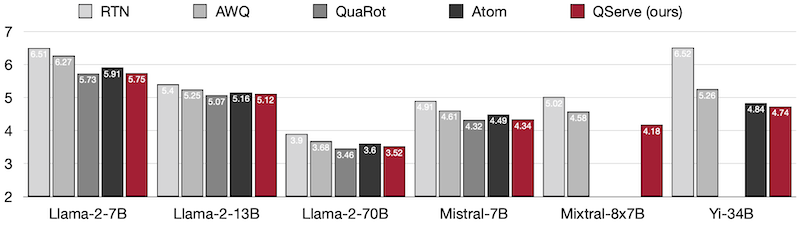
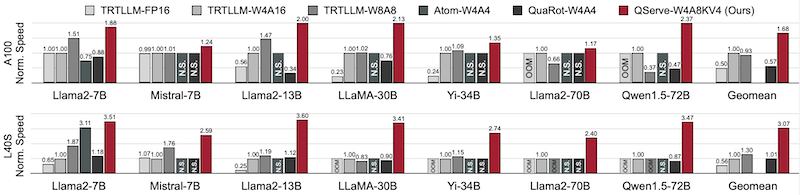
또한, TensorRT-LLM(W4A16)과 비교한 실험에서도 2.4x에서 3.5x 빠른 속도를 달성하였다. (NVIDIA A100, L40S)