19 Efficient Video Understanding and Generative Models
Lecture 19 - Efficient Video Understanding and Generative Models | MIT 6.S965
EfficientML.ai Lecture 15 - GAN, Video, and Point Cloud (MIT 6.5940, Fall 2023, Zoom)
EfficientML.ai Lecture 17 - GAN, Video, Point Cloud (Zoom Recording) (MIT 6.5940, Fall 2024)
19.5 Generative Adversarial Networks (GANs)
Generative Adversarial Networks 논문(2014)
Thalles' blog: A Short Introduction to Generative Adversarial Networks
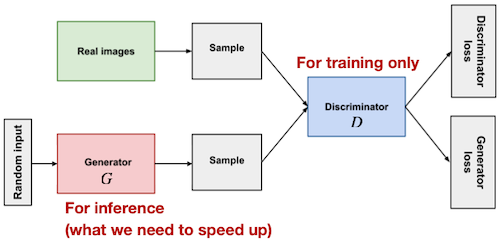
Generative Adversarial Networks(GANs)은 Generator(생성자)와 Discriminator(판별자) 두 가지 요소로 구성된다.
-
Discriminator : fake image 판별
-
Generator : Discriminator 에서 fake image를 최대한 판별하지 못하도록 샘플 생성
다음은 GAN의 목적 함수다.
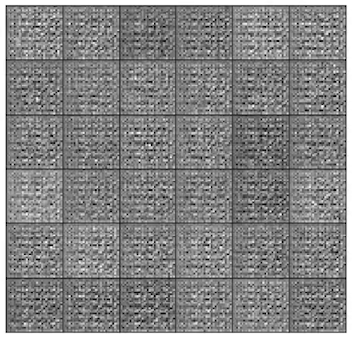
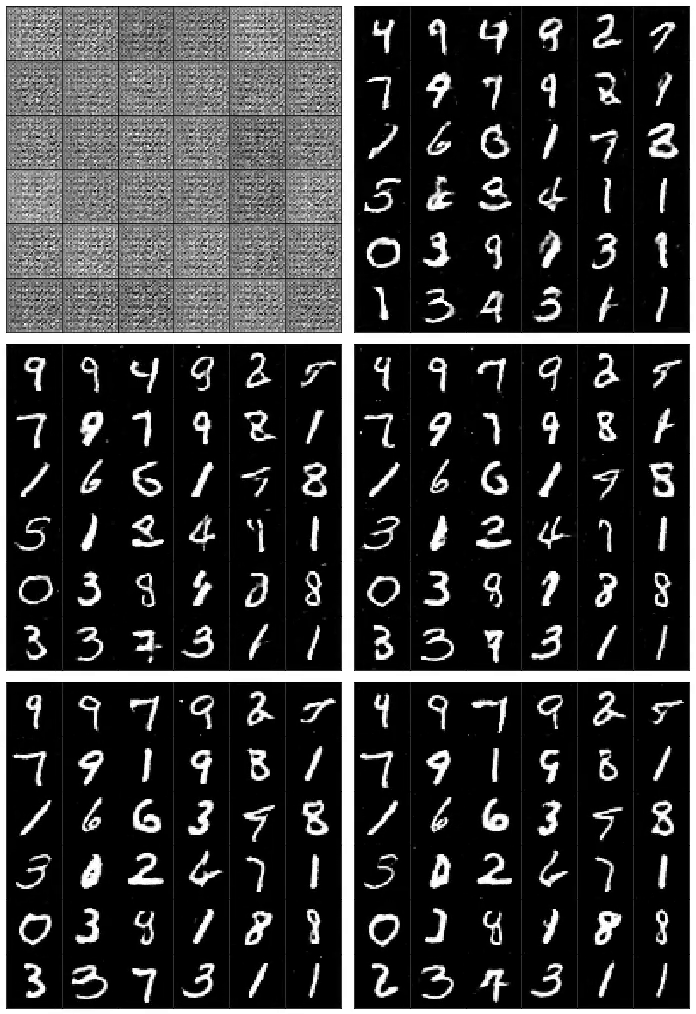
다음은 MNIST 학습에서 Generator가 생성한 샘플을 시각화한 그림이다. 무작위 초기화로 시작하여 digit을 생성하기까지 학습한다.
| Random initialization | Training |
|---|---|
 |
 |
GAN 성능 평가지표: IS(Inception Score) 혹은 FID(Frechat Inception Distance)을 주로 사용
19.5.1 Conditional vs Unconditional GANs
Polygon generation and video-to-video translation for time-series prediction 논문(2022)
Aditya Sharma: Conditional GAN (cGAN) in PyTorch and TensorFlow
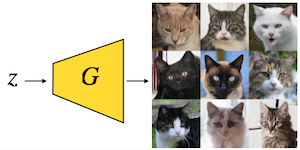
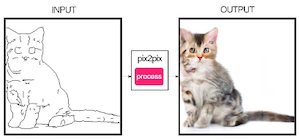
Unconditional GANs은 random noise를 입력으로 이미지를 생성한다. 반면, Conditional GANs은 label을 추가로 전달받아 이미지를 생성한다.
label: class label, segmentation map, strokes 등
| Type | Description | Example |
|---|---|---|
| Unconditional GAN | 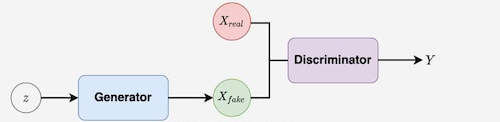 |
 |
| Conditional GAN | 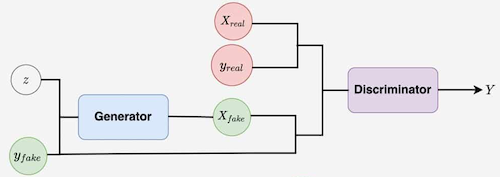 |
 |
19.5.2 Difficulty: GANs are Computational-Intensive
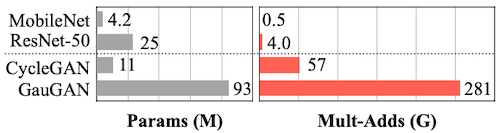
하지만 GANs는 recognition 모델에 비해 연산에 더 많은 비용이 필요하다.
19.6 GAN Compression: Compressing Generators
GAN Compression: Efficient Architectures for Conditional GANs 논문(2020)
GAN Compression은 NAS 및 지식 증류를 활용하여 cGAN Generator를 압축한 연구다.
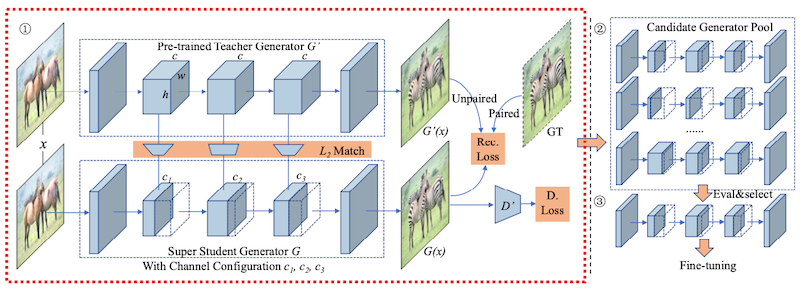
①: (NAS) Super Generator 학습
- cGAN Loss
- Reconstruction Loss
이때 교사 모델의 출력을 함께 사용하면 성능에 도움이 된다. (unpaired to paired learning)
- Distillation Loss (교사 모델: 사전학습 Generator)
레이어마다 intermediate representation 증류 (이때 교사-학생 차원이 일치하도록 projection 포함)
②: Evolutionary Search(진화 탐색): 최적의 지연시간-정확도 trade-off 설정 탐색
③: fine-tuning
19.7 Anycost GANs: Dynamic Cost vs Quality
Anycost GANs for Interactive Image Synthesis and Editing 논문(2021)
사용자에게 제공할 preview 생성 등의 목적으로, quality를 희생하더라도 지연시간을 최소화해야 하는 경우가 있다. (dynamic cost)
Anycost GANs 논문에서는 이를 위한 동적 신경망(해상도 및 채널 수) 기반 GAN 모델을 제안하였다.
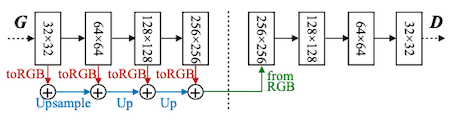
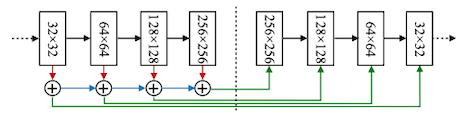
- Dynamic Resolution
| StyleGAN2 | MSG-GAN | Anycost GANs |
|---|---|---|
 |
 |
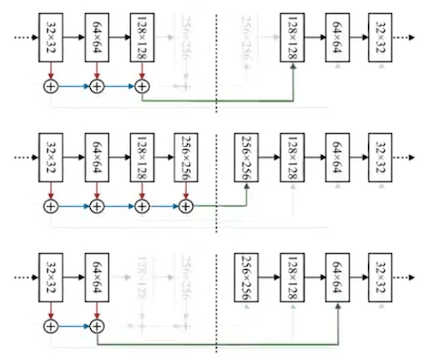 |
| 최대 해상도 전달 (upsampling) | 모든 해상도 사용 | 학습 단계별로 다른 해상도를 샘플링하여, dynamic-res 지원 |
-
Dynamic Channels
-
적은 채널 수(x0.5)에서 성능 저하: 지식 증류(distillation)를 활용해 보완
-
단일 Discriminator에 따른 성능 저하: Generator Architecture를 원-핫 인코딩하여 conditioning
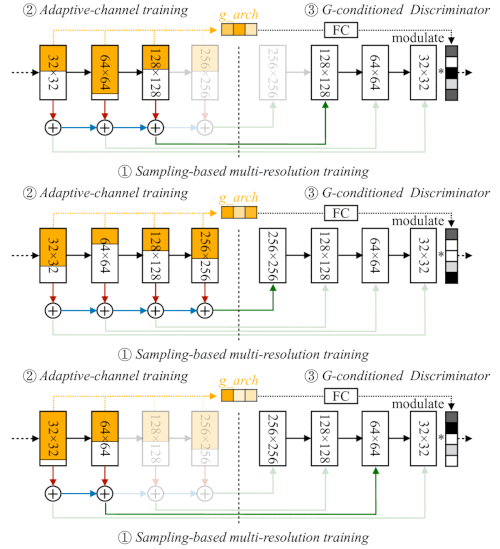
제약조건 내 최적 설정은 Evolutionary Search를 통해 탐색한다.
19.8 Data-Efficient GANs
Differentiable Augmentation for Data-Efficient GAN Training 논문(2020)
적은 데이터로 GAN 모델을 학습할 경우, 주로 Discriminator에서 과적합이 발생하여 성능이 저하된다.
- 학습 데이터 10%만 사용(빨간색): Discriminator 검증 정확도 하락 (overfitting)
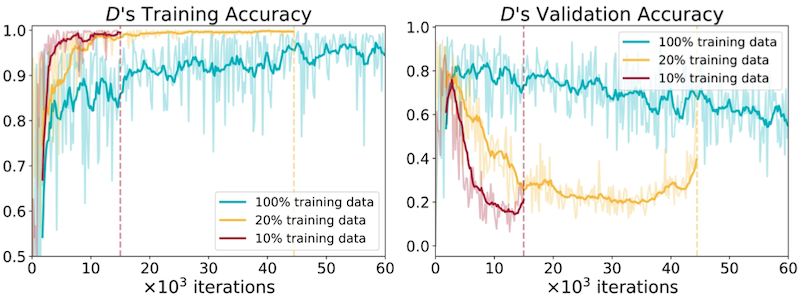
논문에서는 과적합을 완화할 효과적인 data augmentation으로 Differentiable Augmentation(DiffAugment)를 제안하였다.
-
real , 가우시안 분포 기반 fake
-
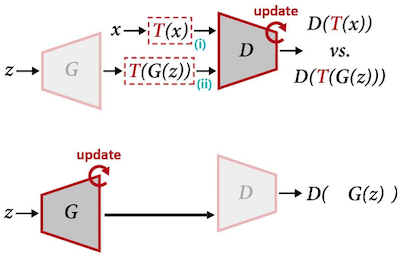
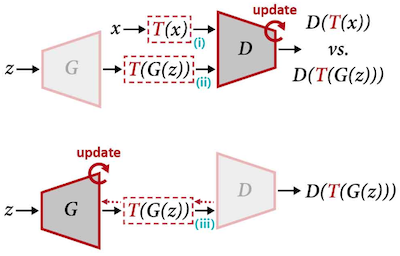
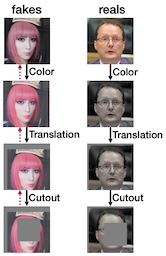
Discriminator, Generator 모두에게 reals, fakes 대상 augmentation 적용 (=역전파 가능)
| Update | Example |
|---|---|
 |
 |
Notes: 일반적인 데이터 증강 사용 시 문제
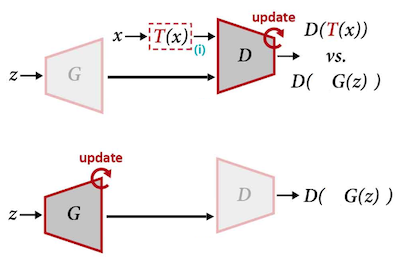
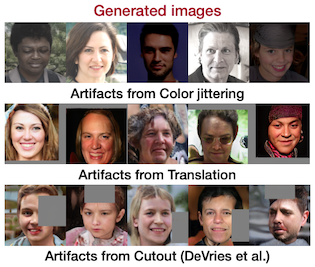
(1) Real Images만 증강: 생성된 결과 이미지에 동일한 artifacts가 반영되는 문제가 발생한다.
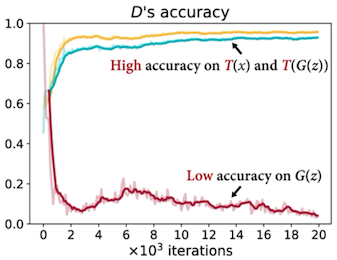
Update Example (2) Discriminator만 reals, fakes 증강: augmentation을 적용하지 않을 때 심한 성능 저하가 발생한다.
Update Example