10 Knowledge Distillation
Lecture 10 - Knowledge Distillation | MIT 6.S965
EfficientML.ai Lecture 9 - Knowledge Distillation (MIT 6.5940, Fall 2023, Zoom)
Knowledge Transfer란, 복잡한 모델을 사용하여 단순한 모델을 훈련시킴으로써, 복잡한 모델 성능에 근접한 단순한 모델을 획득하는 방법이다.
10.1 Cloud Model vs Edge Model
cloud model(ResNet50)과 edge model(MobileNetV2-Tiny)의 training curve를 비교해 보자.
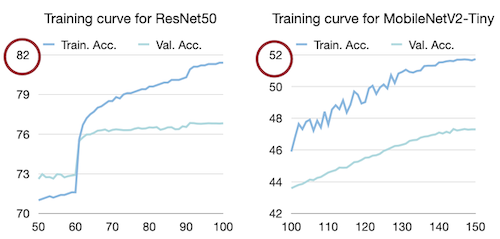
가로: epoch, 세로: accuracy
위 그래프에서 볼 수 있듯이, edge model(MobileNetV2-Tiny)은 다음과 같은 특징을 갖는다.
-
(-) 작은 capacity를 갖는 만큼, 높은 정확도를 얻기 힘들다.
-
(-) overfitting을 방지하기 위한 학습 기법이, 오히려 정확도 하락을 유발할 수 있다.
data augmentation(데이터 증강), dropout(드롭아웃) 등
data augmentation: mirroring, random cropping, rotation, shearing, local wrapping 등
10.2 Knowledge Distillation
Knowledge Distillation(KD, 지식 증류)란, teacher가 갖고 있는 knowledge를 student network로 전달하는 방법이다.
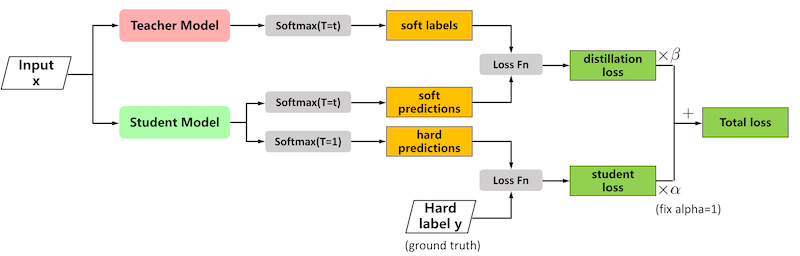
ground-truth: 실험자가 정한 '정답'(model이 답으로 내놓기를 원하는 class)
-
Input: Teacher, Student 모두에게 전달된다.
-
Distillation Loss
다음 두 정보의 차이를 바탕으로 산출한다.
-
soft labels = Teacher Logits + Softmax with Temperature
-
soft predictions = Student Logits + Softmax with Temperature
-
Classification Loss = student's standard loss
-
Total loss = classification loss + distillation loss
10.2.1 Intuition of Knowledge Distillation
개와 고양이의 이진 분류 문제 예시를 바탕으로 KD를 이해해 보자.
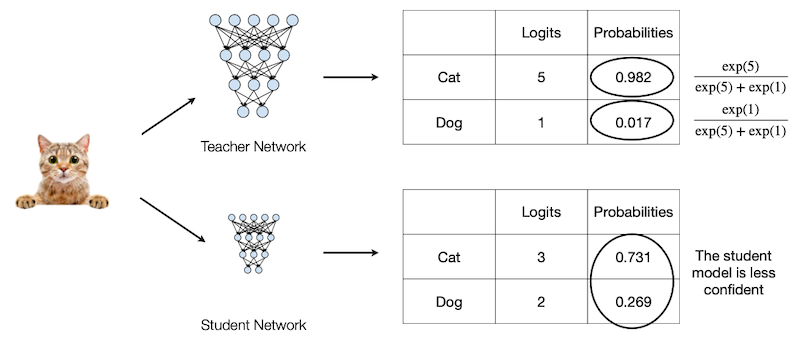
위 결과에서, teacher와 student가 입력을 고양이로 예측한 확률은, softmax를 통해 계산할 수 있다.
- Teacher
- Student
student는, teacher에 비해 입력이 고양이라는 confidence가 부족하다. 이를 teacher model의 information으로 보완한다.
10.2.2 Softmax Temperatrue
하지만 teacher의 confidence가 높을수록, 정답이 아닌 다른 class의 information이 0에 가깝게 된다. teacher의 information을 보존하여 전달하기 위해, temperature라는 개념이 등장한다.
-
: temperature
-
가 클수록, soft한 distribution이 된다.
-
: standard softmax
-
teacher와 student 크기 차이가 클 때는, 대체로 작은 temperature가 더 효율적이다.
student가 teacher의 information을, 제대로 capture하지 못하기 때문.
📝 예제 1: Softmax Temperature
다음 예시에서, 일 때 입력을 고양이로 예측한 확률을 구하라.
| Logits | |
|---|---|
| Cat | 5 |
| Dog | 1 |
🔍 풀이
- (standard softmax)
10.3 What to match?
이후 다양한 연구에서 logits(response)만 아니라, 교사의 다른 정보를 학생과 match하는 방법들이 제안되었다.
10.3.1 Matching intermediate weights
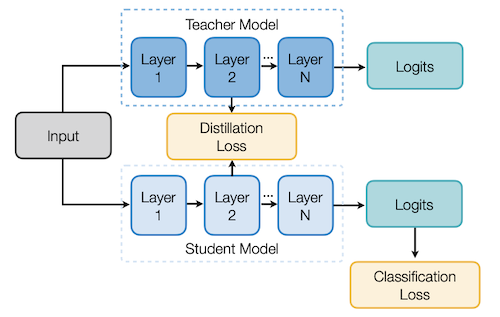
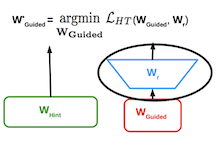
FitNets 논문에서는, 교사와 학생의 각 레이어의 intermediate weights를 비교하여 Distillation Loss를 산출한다.
-
교사 가중치와 학생 가중치의 L2 distance를 측정한다.
-
이때 채널 수가 적은 학생에 1x1 convolution을 적용하여, 교사와 동일한 채널을 갖도록 projection한다. (linear transformation)
10.3.2 Matching intermediate features
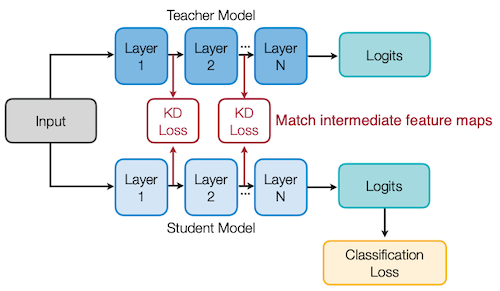
교사와 학생 사이의 feature map을 매칭하는 기법도 제안되었다.
10.3.2.1 Minimizing MMD
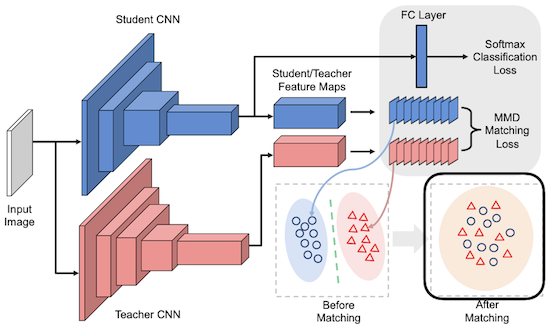
Like What You Like: Knowledge Distill via Neuron Selectivity Transfer 논문(2017)
Like What You Like 논문에서는 MMD(Maximum Mean Discrepancy. 최대 평균 불일치)를 기반으로, 교사와 학생의 feature map discrepancy를 계산한다.
10.3.2.2 Matching intermediate attention maps
위 논문에서는 교사와 학생의 attention map을 매칭한다.
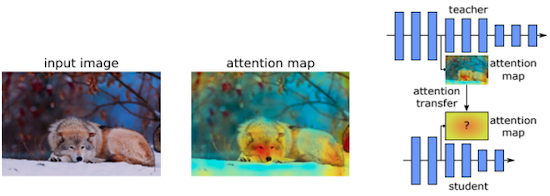
이때 attention의 다음과 같은 특징에 주목한다.
- CNN feature map 의 attention
-
intuition: position 의 attention이 크다면, 해당 지점에 작은 변화(perturbation)를 주어도 최종 출력에 큰 영향을 미칠 것이다.
-
높은 정확도를 갖는 모델은, 비슷한 attention map을 갖는다.

10.3.2.3 Minimizing the L2 distance
Paraphrasing Complex Network: Network Compression via Factor Transfer 논문(2018)
위 논문에서는 Paraphraser, Translator를 두어, 교사의 output feature maps에서 한 차례 더 feature extraction을 거친 정보를 전달한다.(factor transfer)
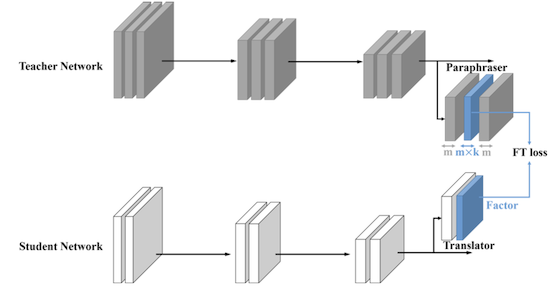
| Paraphraser | Translator | |
|---|---|---|
| Implementation | convolution | 1 layer MLP |
10.3.3 Matching sparsity pattern
Knowledge Transfer via Distillation of Activation Boundaries Formed by Hidden Neurons 논문(2019)
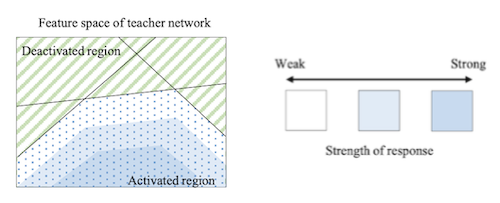
ReLU를 거치며 생기는 activated, deactivated 영역은, 입력을 바르게 구분하기 위한 linear decision boundary를 형성한다.
-
decision boundary는 activation boundary와 큰 연관성을 갖는다.
-
따라서 sparsity pattern으로도, 교사가 가지는 정보를 전달할 수 있다.
위와 같은 아이디어를 기반으로, 다음과 같이 교사의 sparsity pattern 정보를 학생에게 전달한다.
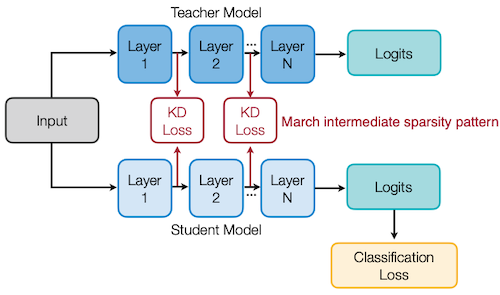
- Sparsity Pattern
indicator function을 사용해서 나타낼 수 있다.
- Loss Function
10.3.4 Matching relational information
서로 다른 레이어나 데이터 사이의 관계, 즉 relational information에 주목한 Knowledge Distillation 기법도 제안되었다.
10.3.4.1 Relations between different layers
다음 그림은 32개 레이어를 갖는 교사와, 14개 레이어를 갖는 학생 모델 사이에서 relational information을 전달하는 과정이다.
이때 교사와 학생의 레이어 수는 다르나, 채널 수는 모두 동일하므로 주의.
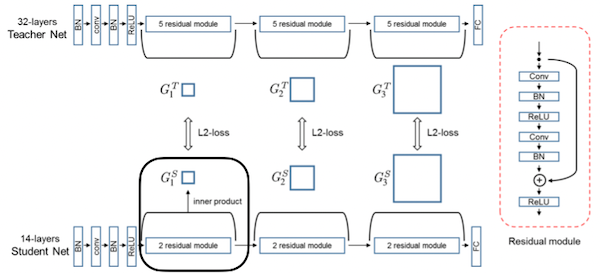
- module 묶음 내 feature map을 내적하여, FSP matrix를 산출한다.
Flow of Solution Procedure(FSP) matrix
- 교사와 학생 FSP matrix의, L2 loss를 계산한다.
10.3.4.2 Relations between different samples
Relational Knowledge Distillation(RKD) 논문에서는, 여러 입력 샘플을 주었을 때, 각 샘플의 intermediate features가 갖는 관계를 전달한다.
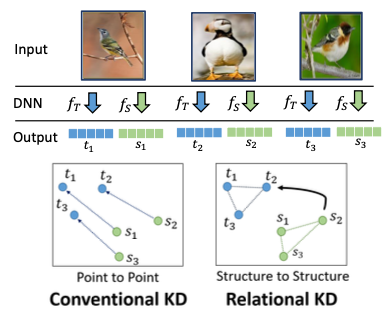
- 이때 개 sample의 relation은, 다음과 같은 수식으로 계산할 수 있다.
10.4 Distillation Schemes
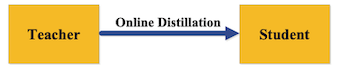
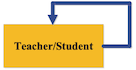
교사와 학생이 동시에 학습되는지 여부에 따라서, KD를 세 가지 범주로 분류할 수 있다.
| Offline Distillation | Online Distillation | Self-Distillation |
|---|---|---|
 |
 |
 |
빨간색: Pre-trained, 노란색: To be trained
10.4.1 Self Distillation
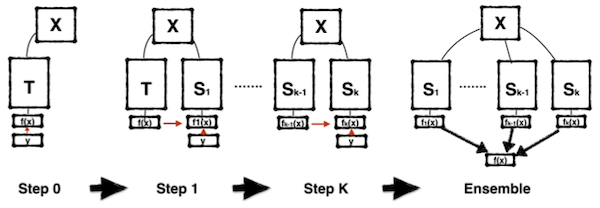
위 논문에서는 stages로 학습 과정을 나누고, 매 stage에서 동일한 구조의 모델을 학습한다.
-
이전 stage에서 획득한 모델을 교사로 하여, iterative하게 학습을 진행한다.
-
Network Architecture
- Accuracy
- 각 stage model의 예측을 ensemble하여, 예측 정확도를 추가로 높일 수 있다.
10.4.2 Online Distillation
Online Distillation에서는, 교사와 학생을 동시에 from scratch로 학습한다.
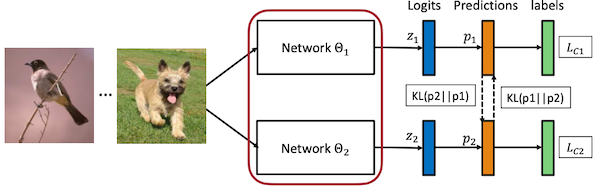
- 교사와 학생의 output distribution 차이를 최소화하는 방식으로 학습이 진행된다.
-
(+) pretrained teacher 가 필요하지 않다.
-
(+) 두 모델이 같은 구조를 가져도 적용할 수 있다. ( )
-
(-) 동시에 학습하는 학생이 많을수록, 학습 자원도 많이 소모된다.
10.4.3 Combining Online and Self-Distillation
10.4.3.1 ONE: Multiple Branches + Ensemble
Knowledge Distillation by On-the-Fly Native Ensemble 논문(2018)
Online Distillation은 여러 학생을 학습하면서 학습 자원을 많이 소모하고, 동시다발적이고 복잡한 backpropagation 알고리즘을 갖는다. ONE 논문에서는 해당 문제를 개선하기 위해, 다양한 branch를 갖는 단일 모델에서 Distillation을 구현했다.
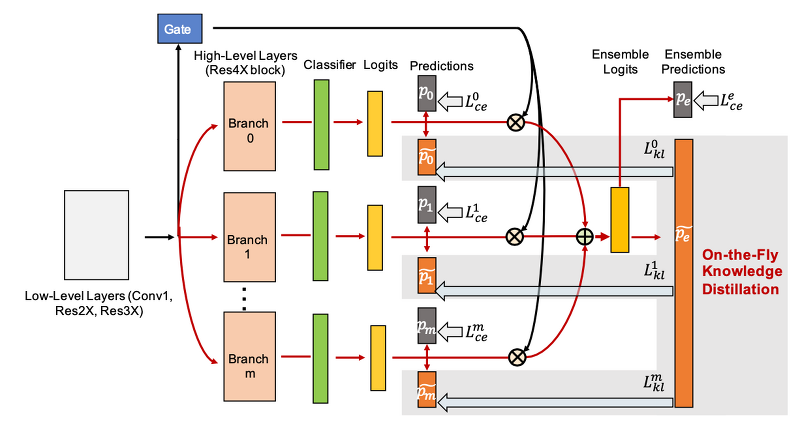
- Gate: 각 branch의 출력 logits을 ensemble한다.
10.4.3.2 Be Your Own Teacher: Deep Supervision + Distillation
위 논문에서는, 출력부에 가까운 레이어(deeper layer)의 지식을, 입력부와 가까운 레이어(shallower layer)로 전달하는 방식으로 Distillation을 구현했다.
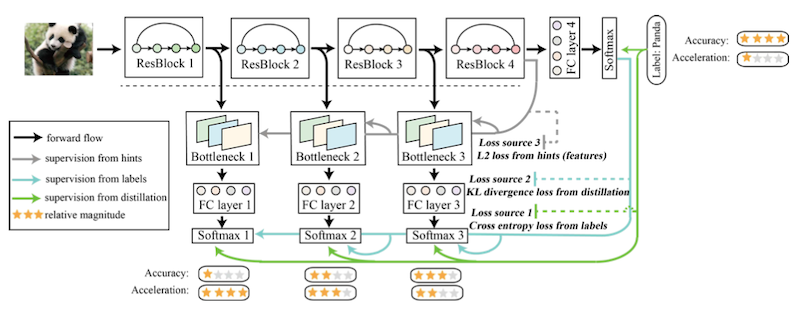
- 예를 들어, 깊은 레이어(예: ResBlock4)에서, 더 얕은 레이어(ResBlock 3)에게 지식이 전달된다.
서로 다른 채널 수: 1x1 conv를 이용해 맞춘다.