Lecture 06 - Quantization (Part II)
Lecture 06 - Quantization (Part II) | MIT 6.S965
Neural Network Quantization Technique - Post Training Quantization
6.6 Quantization-Aware Training(QAT)
Quantization-Aware Training(QAT)이란 training 혹은 re-training(fine-tuning)을 통해, 최적의 quantization scheme을 찾는 방법이다.
| PTQ | QAT | |
|---|---|---|
| 속도 | 대체로 빠르다 | 느리다 |
| re-training | 불필요 | 필요 |
| Plug and Play | 가능 | re-training 필요 |
| accuracy drop | 조절하기 힘들다. | 어느 정도 조절할 수 있다. |
Plug and Play(PnP): 별다른 설정없이 적용 가능
6.6.1 Simulated/Fake Quantization
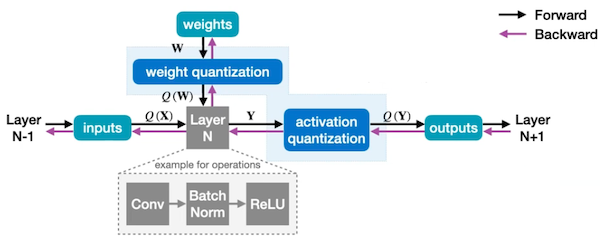
모델의 학습 과정에서, 양자화 후 정확도를 미리 확인하는 simulation을 통해 최적의 양자화 정책을 결정할 수 있다. (simulated quantization = fake quantization)
-
훈련 중 weight W의 full precision copy는 유지된다.
-
정수 값을 사용하면 포착하지 못할 small gradient를 문제 없이 반영할 수 있다.
-
훈련 후 실제 추론에서는 quantized weight를 사용한다.
다음은 simulated quantization 방법을 통해, linear quantization 기반 weight, activation quantization을 수행하는 연산 그래프다.
- Weight quantization
- Activation quantization
6.6.2 Straight-Through Estimator(STE)
Estimating or Propagating Gradients Through Stochastic Neurons for Conditional Computation 논문(2013)
UNDERSTANDING STRAIGHT-THROUGH ESTIMATOR IN TRAINING ACTIVATION QUANTIZED NEURAL NETS 논문(2019)
하지만 양자화된 값은 discrete하므로, 거의 대부분의 경우에서 미분 값은 0이 된다.
따라서 다음과 같이 gradient update 과정 역시 불가능하게 된다.
이러한 문제를 해결하기 위해 등장한 방법이 Straight-Through Estimator(STE)이다.
-
deriative를 무시하고, identity function처럼 고려한다.
-
따라서 quantized weight만으로 바로 gradient update를 수행한다.
6.6.3 INT8 Linear Quantization-Aware Training
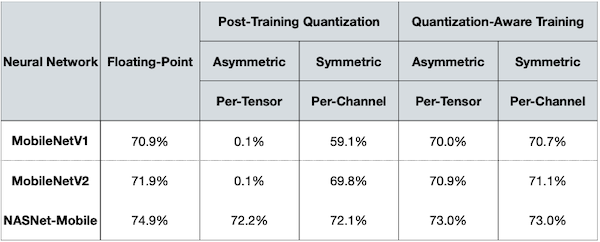
Quantizing deep convolutional networks for efficient inference: A whitepaper 논문(2017)
작은 모델에서는 INT8 linear QAT 방법이, PTQ보다 훨씬 더 좋은 정확도를 갖는 것을 알 수 있다.
6.7 Binary Quantization
Binary Quantization은 더 나아가 1 bit만을 사용하는 양자화 방식이다.
-
storage: binary weights
-
computation: bit operation
real number weight 연산과, binary quantizated weight 연산을 비교해 보자.
| baseline | Real Number Weights | Binary Quantized Weights |
|---|---|---|
 |
 |
 |
| operation | + x | + - |
| memory | 1x | ~32x less |
| computation | 1x | ~2x less |
Binarization은 크게 deterministic binarization, stochastic binarizaion 방법으로 나뉜다.
-
Deterministic Binarization
정해둔 threshold 이상인 값은 1, 미만인 값은 -1로 양자화한다.(sign function)
-
Stochastic Binarization
global statistics 혹은 input data를 바탕으로, 양자화 시 -1, +1 probability를 결정한다.
6.7.1 Binarize the weights
BinaryConnect: Training Deep Neural Networks with binary weights during propagations 논문(2015)
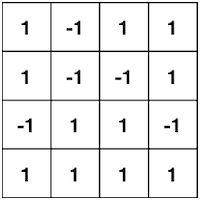
대표적으로 BinaryConnection 논문은 다음과 같이 양자화한다.
- discrete한 정도를 averaging할 수 있도록, hard sigmoid를 이용해서 probability를 결정한다.( )

-
(-) 하지만 정확도 손실이 크다. (ImageNet 대상 AlexNet Top-1 accuracy: -21.2%p)
-
(-) 하드웨어에서 probability 계산을 위한 함수를 지원하지 않을 수 있다.
6.7.2 Binarize the weights with scaling factor
XNOR-Net: ImageNet Classification Using Binary Convolutional Neural Networks 논문(2016)
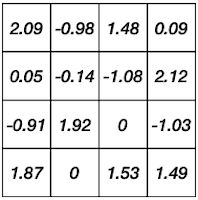
XNOR-Net 논문에서는 weight binarization에 따른 정확도를 회복하기 위해, binarized weight tensor(fp32)에 FP32 scaling factor를 추가한다.
| weights (32bit float) |
BinaryConnection | XNOR-Net |
|---|---|---|
 |
 |
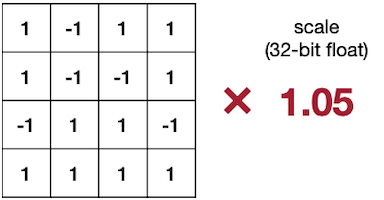 |
이러한 scaling factor 는, 양자화 전 가중치 행렬 원소(FP32)의 절대값 평균을 사용한다.
6.7.3 Binarize the weights and activations
혹은 weight과 activation에 모두 binary quantization을 적용할 수 있다. 이 경우 모든 연산을 XNOR 연산으로 대체할 수 있다. 가령 다음과 같은 연산을 생각해 보자.
-
연산의 가능한 경우의 수는 다음과 같다.
W X Y=WX 1 1 1 1 -1 -1 -1 -1 1 -1 1 -1 -
-1 대신 0으로 바꾸면, XNOR 진리표와 완전히 일치한다.
XNOR( ) 1 1 1 1 0 0 0 0 1 0 1 0
앞선 예시와 비교 시, 메모리는 32배 이상, 연산은 58배 이상 줄어든다.
| input | weight | operations | memory | computation |
|---|---|---|---|---|
| + x | 1x | 1x | ||
| + - | ~32x less | ~2x less | ||
| xnor, popcount | ~32x less | ~58x less |
📝 예제 1: Binary Weight Quantization
다음 행렬 연산을 xnor 연산으로 계산하라.
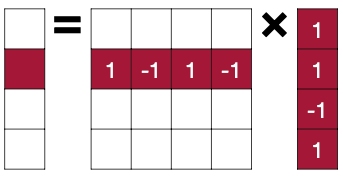
🔍 풀이
하지만 단순히 -1을 0으로 치환해서는 다른 결과가 나오게 된다. 따라서 다음과 같은 보정을 거쳐야 한다.
-
1: 본래 -1, 1의 차이인 2를, 1의 개수만큼 더해준다.
-
0: -1을 치환한 값이므로, 0의 개수만큼 -1을 더해준다.
위 식을 다음과 같이 일반화할 수 있다.
이는 원소 중 1의 개수가 얼마나 있는지를 파악하는, popcount 연산으로 대신할 수 있다.
6.7.3 Accuracy Degradation of Binarization
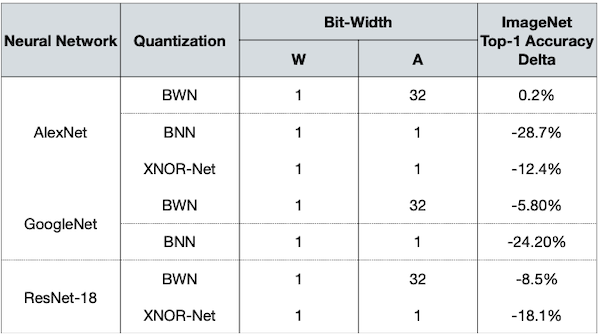
다음은 다양한 binary quantization에 따른 정확도 변화를 정리한 도표이다.
-
BWN: scaling factor를 사용하는 Binary Weight Network
-
BNN: scale factors를 사용하지 않는 Binarized Neural Network
6.8 Ternary Quantization
1bit만을 사용하는 binary quantization보다 정확도를 보존하기 위해, 2bit(-1, 0, 1)를 사용한 quantization Ternary Weight Networks(TWN)가 등장했다.
앞선 예시에 ternary quantization을 적용해 보자.
- threshold
- scaling factor
non-zero 값을 바탕으로 l1 norm을 계산한다.
| weights (32bit float) |
ternary weights (2bit) |
|---|---|
 |
 |
6.8.1 Trained Ternary Quantization(TTQ)
Trained Ternary Quantization(TTQ) 논문에서는, 기존의 -1, 0, 1 대신 훈련 가능한 , 패러미터를 도입한 ternary quantization을 적용한다.

-
full precision 가중치를 [-1, 1] 사이로 normalize한다.
-
threshold에 따라 -1, 0, 1로 ternary quantization을 수행한다.
-
scale parameter , 를 훈련한다.
다음은 ImageNet 대상 ResNet-18 모델에서, full precision, BWN, TWN 각각의 Top-1 accuracy를 비교한 도표다.
| ImageNet Top-1Accuracy | Full Precision | BWN(1 bit) | TWN(2 bit) | TTQ |
|---|---|---|---|---|
| ResNet-18 | 69.6 | 60.8 | 65.3 | 66.7 |