Lecture 05 - Quantization (Part I)
Lecture 05 - Quantization (Part I) | MIT 6.S965
EfficientML.ai Lecture 5 - Quantization (Part I) (MIT 6.5940, Fall 2023, Zoom recording)
5.8 How Many Bits to Quantize Weights?
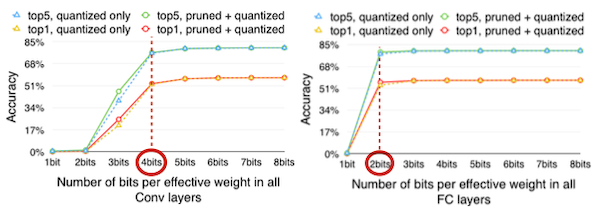
양자화를 위한 bit width는 어느 정도가 적당할까? 다음은 AlexNet의 Convolution, Fully-Connected 레이어에서, bit width 변화에 따른 정확도 변화를 나타낸 그래프다.
-
Conv layer: 4bits까지 정확도 유지
-
FC layer: 2bits까지 정확도 유지
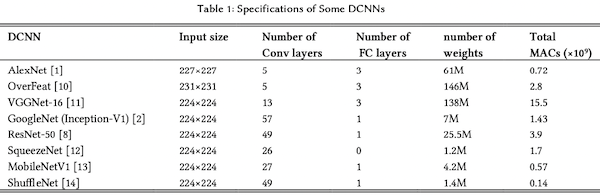
참고로 대표적인 CNN 모델에서 Conv, FC layer이 갖는 비중은 다음과 같다.
5.9 Deep Compression: Vector Quantization
Deep Compression 논문은 (1) iterative pruning, (2) vector quantization(VQ), (3) Huffman encoding 방법을 기반으로, 가중치가 차지하는 메모리를 획기적으로 줄이는 방법을 제안했다.
| Iterative Pruning | Vector Quantization(VQ) | Huffman Encoding | ||
|---|---|---|---|---|
 |
 |
 |
||
| original network 대비 크기 9x-13x 감소 |
original network 대비 크기 27x-31x 감소 |
original network 대비 크기 35x-49x 감소 |
5.9.1 K-Means-based Weight Quantization
Deep Compression에서는 K-Means Algorithm 기반의, non-uniform weight quantization을 수행한다.(Vector Quantization)
#quantization levels = #clusters
Computer Graphics에서도 65536개의 스펙트럼으로 이루어진 원래 색상을, 256개 bucket을 갖는 codebook을 만들어서 유사하게 양자화한다.
-
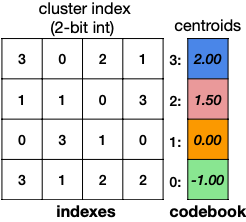
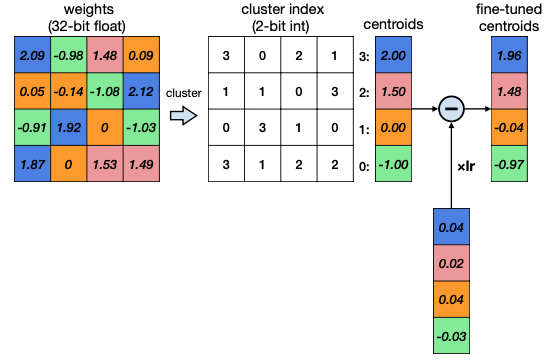
storage: Integer Weights, Floating-Point Codebook
-
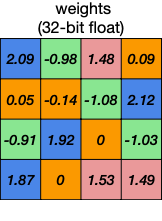
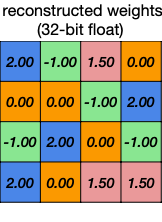
codebook: 예시 기준으로 FP32 bucket 4개를 사용한다.
-
cluster index: bucket이 4개이므로, 2bit(index 0,1,2,3)로 충분하다.
-
computation: Floating-Point Arithmetic
| Weights (FP32 x 16) |
압축 | cluster index(INT2 x 16) centroids (FP32 x 4) |
추론 | Reconstructed (FP32 x 16) |
|---|---|---|---|---|
 |
→ |  |
→ |  |
📝 예제 1: K-Means-based Quantization의 메모리 사용량
위 예시 그림에서 K-Means-based Quantization 이전/이후 사용하는 메모리 사용량을 계산하라.
🔍 풀이
- 양자화 전
FP32 weight matrix
-
양자화 후
-
weight matrix: INT2 x 16
- codebook: FP32 x 4
따라서 양자화 전 필요한 메모리 사용량은 64 bytes, 양자화 후 필요한 메모리 사용량은 20 bytes이다.(3.2배 사용량 감소)
weight tensor가 크면 클수록, 가중치의 메모리 사용량 감소 효과가 더 커진다.
5.9.2 Finetuning Codebook
위 예시에서 weight를 다시 reconstruct(decode)한 뒤, error를 계산해 보자.
| 양자화 전 | Decompressed | Error |
|---|---|---|
|
|
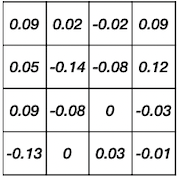 |
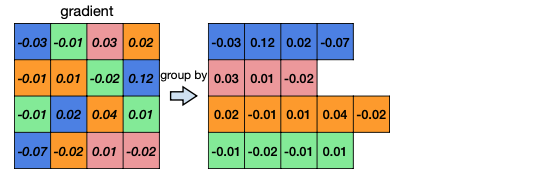
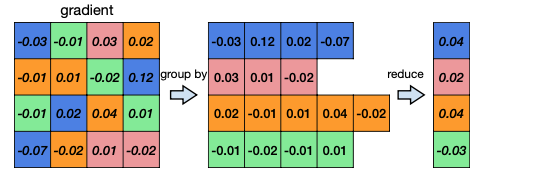
이러한 quantization error는 양자화 전, 후의 가중치 값 차이를 줄이는 방식으로, codebook을 fine-tuning하며 개선할 수 있다.
-
cluster index에 따라 quantization error를 분류한다.
-
mean error를 구한다.
-
codebook의 centroid를 업데이트한다.
5.9.3 K-Means-based Quantization Limitations
그러나 K-Means-based weight quantization은 다음과 같은 한계점을 갖는다.
-
(-) 연산 시 다시 floating point로 reconstruct된다.
-
(-) reconstruction 과정에서 time complexity, computation overhead가 크다.
-
(-) weight가 메모리에서 연속적이지 않기 떄문에, memory access에서 긴 지연이 발생하게 된다.
-
(-) activation은 입력에 따라 dynamic하게 변하므로, activation quantization으로 clustering-based approach는 적합하지 않다.
5.9.4 Huffman Coding
추가로 Huffman Coding 알고리즘을 적용하여 memory usage를 더 줄일 수 있다.
Unix의 파일 압축, JPEG, MP3 압축에서 주로 사용된다.
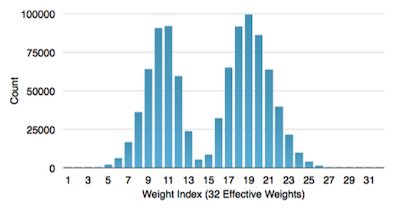
Encoding의 분류는 크게 두 가지로 나뉜다. 고정된 길이로 encode하는 RLC(Run Length Coding), 가변 길이로 encode하는 VLC(Variable Length Coding). Huffman Coding은 대표적인 VLC에 해당된다.
-
frequent weights: bit 수를 적게 사용해서 표현한다.
-
In-frequent weights: bit 수를 많이 사용해서 표현한다.
📝 예제 2: Huffman Coding
a, b, c 알파벳을 Huffman Coding을 이용해 압축하라.
ASCII code로 표현하려고 한다면 INT8 x 3으로 24bits를 사용해야 한다. 하지만 Huffman coding을 적용하여 메모리 사용량을 줄일 수 있다.
🔍 풀이
a, b, c를 다음과 같이 압축하여 정의했다고 하자.
-
Try 1
a b c 01 101 010
a와 c의 접두어 부분(01)이 겹치기 때문에 VLC로 압축할 수 없다.
-
Try 2
a b c 01 10 111
겹치는 접두어가 없기 때문에, 01 10 111 = 총 7bits로 압축할 수 있다.
5.10 AND THE BIT GOES DOWN: Product Quantization
AND THE BIT GOES DOWN: REVISITING THE QUANTIZATION OF NEURAL NETWORKS 논문(2019)
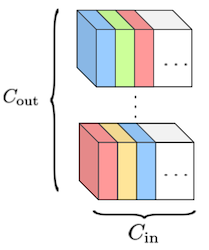
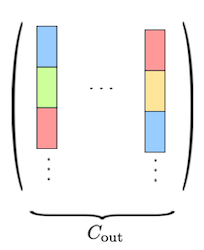
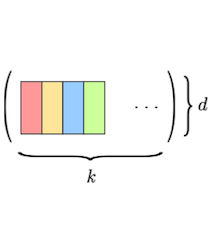
어떤 레이어가 크기의 3D 텐서 개를 갖는다고 하자. 위 논문에서는 합성곱 필터가 갖는 spatial redundancy를 이용할 수 있도록, 크기를 갖는 subvector 단위로 vector quantization을 적용한다.
-
각 3차원 텐서를, subvector 개로 구성된 단일 벡터로 reshape한다.
-
subvector size :
-
#subvectors per vector:
-
(크기 를 갖는) subvector 개로 구성된 codebook 기반으로 양자화한다.
| Filters | Reshaped filters | Codebook |
|---|---|---|
 |
 |
 |
5.10.1 Product Quantization
앞서 살펴본 Vector Quantization(VQ)는 Product Quantization(PQ)의 특수한 경우로 볼 수 있다. 다음은 Product Quantization의 두 가지 경우를 비교한 표다.
| Vector Quantization | Scalar K-means algorithm | |
|---|---|---|
| subvector size | ||
| #subvectors per vector |
또한 product quantization에서 codebook 는, 크기 를 갖는 centroid(codeword) 개로 구성된다.
| Codebook | Codeword | |
|---|---|---|
 |
 |
|
| dimension |
📝 예제 3: Product Quantization의 메모리 사용량
다음과 같은 조건에서 Product Quantization으로 사용되는 메모리 사용량을 계산하라.
-
입력 레이어:
-
#centroids:
데이터 타입은 float16을 사용하며, 각 subvector는 1 byte를 차지한다고 가정한다.
- block size:
🔍 풀이
메모리 사용량은 크게 (1) indexing cost와 (2) FP16 타입의 centroid가 차지하는 메모리로 나뉜다.
- indexing cost
입력 레이어의 #blocks 은 개다. 따라서 16kB 메모리를 차지한다.
- centroids
FP16을 사용하므로, 256개 centroids가 차지하는 메모리는 다음과 같다.
5.10.2 Minimize Difference between Output Activations
최적의 centroid(codeword)를 찾기 위한 방법을 살펴보자. 먼저 양자화 전,후 가중치 값을 비교하며, quantization error를 최소화하는 objective function은 다음과 같이 정의할 수 있다.
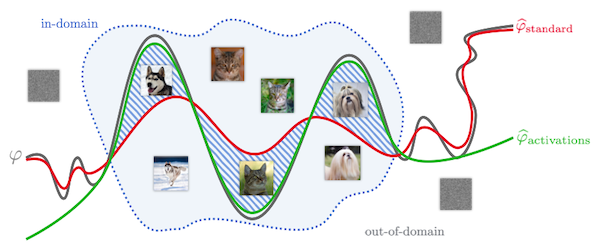
하지만 논문에서는 양자화 전,후의 차이를 최소화해 얻은 가중치가, 반드시 양자화 전의 출력과 비슷한 결과를 보장하지 않는다는 사실에 주목한다. 대신 in-domain input을 추론시키면서, activation을 대상으로 양자화 전,후 차이를 최소화하는 objective function을 제안한다.
다음은 개와 고양이를 분류하는 간단한 binary classifier 를 대상으로, 두 가지 objective function을 사용한 결과를 비교한 그림이다.
-
weight-based(빨간색), activation-based(초록색)
-
in-domain 입력에 대해, activation-based objective function으로 최적화한 모델의 성능이 더 우수하다.