Lecture 02 - Basics of Neural Networks
2.5 Efficiency Metrics
보통 network를 설계할 때, 크게 세 가지 요소를 고려한다.
-
latency
-
storage
-
energy
그렇다면 다른 network 사이에서 efficiency(효율성)을 비교할 때 어떤 지표를 사용하여 비교해야 할까?
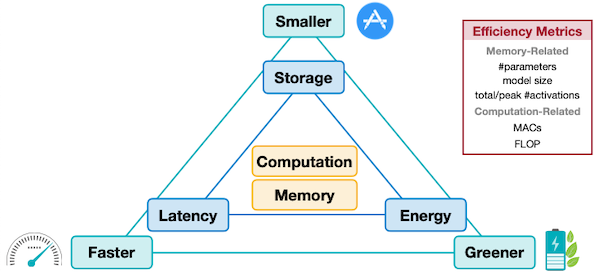
storage가 weight만 의미한다면, memory는 추가로 activation까지 고려한다.
-
Memory-Related
-
#parameters
-
model size
-
total/peak #activations
-
computation
-
MACs
-
FLOP
2.5.1 Latency
Neural Network 추론에 있어서, latency(지연시간)는 NN 자체의 특성과 hardware 특성에 모두 영향을 받는다. 예를 들어 pipelining을 이용하면 computation과 data movement는 동시에 이루어질 수 있다.
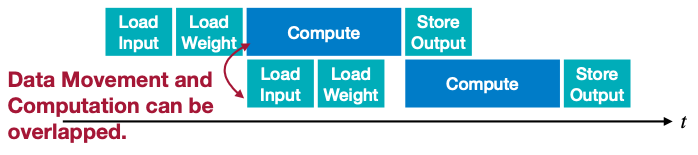
병렬화가 가능한 자원만 충분하다면 latency는 다음 수식으로 계산할 수 있다.
분모는 hardware 특성, 분자는 NN 특성이다.
분모는 hardware 특성, 분자는 NN 특성이다.
weight를 SRAM에 모두 저장하면, main memory에 접근하지 않을 수 있다.
2.5.2 Energy Consumption
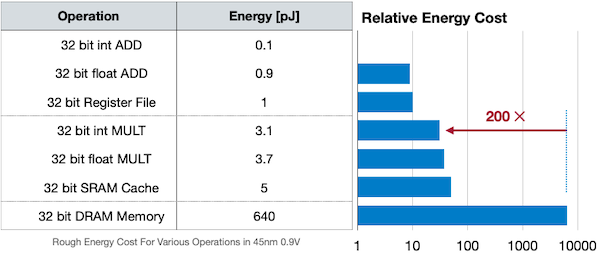
(생략)
2.5.3 Number of Parameters (#Parameters)
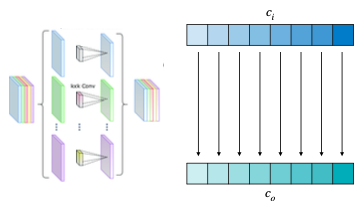
#Parameters는 기본적으로 총 weight 개수를 의미한다. 여러 레이어 종류에 따른 #Parameters를 구해보자.(bias는 무시)
- Linear Layer
: 입력 채널 수(
)와 출력 채널 수(
)를 곱하면 된다.

- Convolution
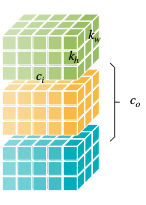
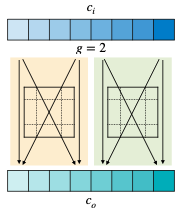
- Grouped Convolution
- Depthwise Convolution
📝 예제 1: AlexNet #Parameters
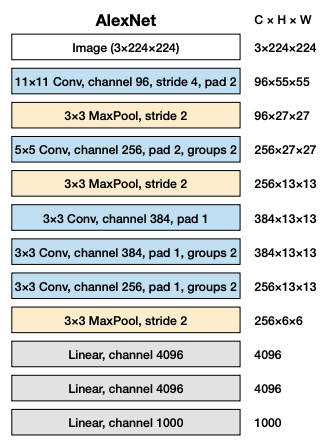
AlexNet의 #Parameters를 구하라. 단, bias는 무시한다.
🔍 풀이
레이어별 #parameters를 구해보자.
- Conv Layer 1
- Conv Layer 2(grouped convolution 1)
- Conv Layer 3
- Conv Layer 4(grouped convolution 2)
- Conv Layer 5(grouped convolution 3)
- Linear Layer 1
- Linear Layer 2
- Linear Layer 3
모든 레이어의 #parameters를 합치면 총 61M이다.
2.5.4 Model Size
model size는 weight가 동일한 bit width를 가진다면 간단히 구할 수 있다.
bit width가 다른 mixed precision model은 계산이 달라진다.
- Model Size = #Parameters Bit Width
📝 예제 2: AlexNet model size
AlexNet이 #Parameters를 61M만큼 갖는다고 할 때, 각 조건에서의 model size를 구하라.
-
weight: fp32 type
-
weight: int8 type
🔍 풀이
- fp32 type(=4 bytes)
- int8 type(=1 byte)
2.5.5 Number of Activations (#Activations)
ResNet과 MobileNetV2를 비교해 보자.
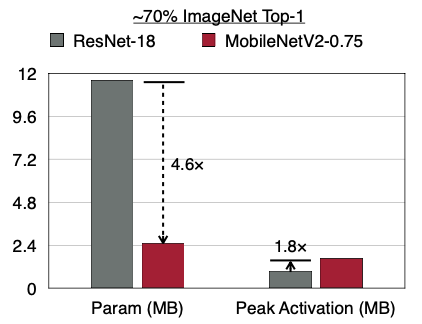
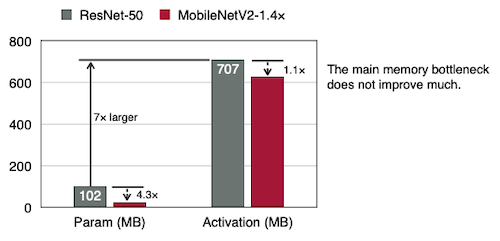
- MobileNetV2: ResNet보다 #Parameter는 적지만, 반대로 Peak Activation은 늘었다.
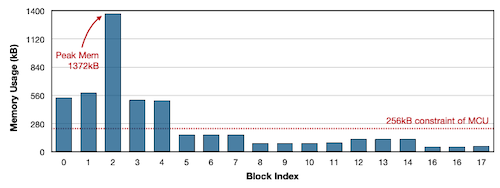
이는 MobileNetV2의 특정 레이어에서 #activations이 memory bottleneck을 일으키는 구조이기 때문이다.
MCUNetV2: Memory-Efficient Patch-based Inference for Tiny Deep Learning 논문
-
입력부와 가까운 레이어의 activation memory가 굉장히 크다.
-
반대로 resolution가 줄어들며 channel 수가 많아지는 후반부는 activation memory가 줄어들지만, 그만큼 많은 filter를 사용하므로 weight memory가 굉장히 커진다.
또한 훈련 중에도 memory bottleneck의 주된 원인은 #Parameter가 아닌 #activations이다.
-
#Parameter, #activations: FP32
-
MobileNetV2이 ResNet보다 #Parameter가 4배 더 적지만, #activations은 1.1배 적다.
📝 예제 3: AlexNet #Activations
AlexNet의 (1) Total #Activations, (2) Peak #Activations를 구하라.
🔍 풀이
...
따라서 Total #Activations, Peak #Activations은 다음과 같다.
- Total #Activations
- Peak #Activations
2.5.6 MACs
computation efficiency를 표현하는 대표적인 지표인 MAC(Multiply-Accumulate) operations를 살펴보자.(MAC 연산은 CNN 연산의 대부분을 차지한다.)
우선 Multiply-Accumulate operation(MAC)은 다음과 같이 곱셈과 덧셈으로 이루어진 연산을 의미한다.
두 가지 대표적인 연산에서 MACs를 구해보자.
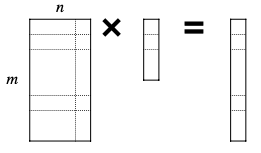
- Matrix-Vector Multiplication(MV)
Matrix-Vector Multiplication 연산에서 MACs는 다음과 같이 계산할 수 있다.
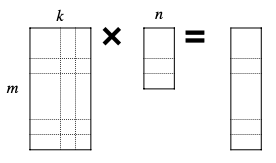
- General Matrix-Matrix Multiplication(GEMM)
Matrix-Matrix 연산에서 MACs는 다음과 같이 계산할 수 있다.
이번에는 여러 레이어 종류별로 계산해 보자.(batch size n=1로 가정)
- Linear Layer
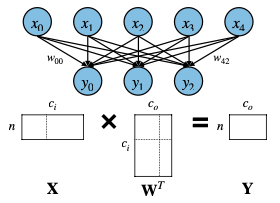
- Convolution
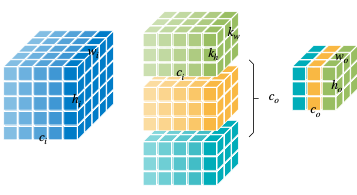
계산에 주의.
다시 말해 output activation 각 픽셀마다 만큼의 MACs를 갖는다는 뜻이기도 하다.
- Grouped Convolution
- Depthwise Convolution
📝 예제 4: AlexNet #MACs
AlexNet의 #MACs를 구하라.
🔍 풀이
- Conv Layer 1
- Conv Layer 2
...
- Linear Layer 1
- Linear Layer 2
- Linear Layer 3
따라서 총 MACs는 724M이다.
2.5.7 FLOP
MAC과 마찬가지로 computation과 관련된 대표적인 지표로 FLOP(Floating Point Operations)이 있다.
processor의 성능 지표인 FLOPS(Floating Point Operation Per Second)와 구분할 것
만약 operations이 다음과 같은 data type이라면, 1 MAC = 2 FLOP이다.
-
multiply: FP32
-
add: FP32
📝 예제 5: AlexNet #FLOP
AlexNet의 FLOPs를 구하라. AlexNet은 총 MACs를 724M개를 갖는다고 한다.
-
multiply: FP32
-
add: FP32