5 Conditioned Generation
Language model은 'generative models of text'로 정의할 수 있다.
이때 text를 생성하기 위해서는, specification이 필요하다. 다음은 conditioned language models의 대표적인 예시다.
| 입력 | 출력 (Text) | Task |
|---|---|---|
| structured data | NL description | NL generation |
| English | French | translation |
| document | short description | summarization |
| utterance | response | response generation |
| image | caption | image captioning |
| speech | transcript | speech recognition |
5.1 Formulation and Modeling
modeling을 위한 수식은 간단히 정의할 수 있다.
- Probability of a Sentence
Conditional Language Models은 다음과 같이 정의된다.
-
Conditional Language Models
-
: added context
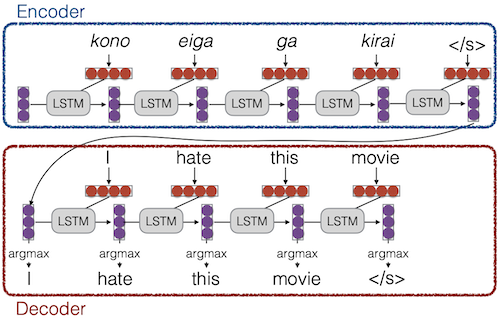
5.1.1 Early Conditional Language Model: Sequence to Sequence
context를 encoding하고 출력을 생성하기 위해서, 주로 encoder와 decoder가 합쳐진 neural network를 사용한다.
5.2 Methods of Generation
모델을 획득했다면 출력을 생성해야 한다. 다음은 generation을 위한 두 가지 대표적인 방법이다.
| sampling | argmax |
|---|---|
| 확률 분포를 기반으로 임의로 생성 | 가장 높은 score를 바탕으로 생성 |
| Ancestral Sampling | Greedy Search, Beam Search |
5.2.1 Ancestral Sampling
Ancestral Sampling은, 단어를 one-by-one으로 임의로 생성하는 방법이다.
(<\/s> : end of sentence)
- while != "<\/s>":
5.2.2 Greedy Search
Greedy Search는, one-by-one으로 가장 높은 확률을 갖는 단일 단어를 생성한다.
- while != "<\/s>":
하지만 greed search는 실전에서 다음과 같은 문제점을 보인다.
-
(-) easy words를 먼저 생성하는 경향이 있다.
-
(-) one rare word보다, multiple common words를 생성하는 경향이 있다.
5.2.3 Beam Search
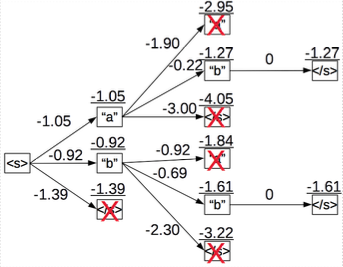
greedy search의 단점을 보완하기 위해, beam search는 k개의 후보를 유지한 뒤 확률을 조사한다. 다음은 beam size 로 설정한 beam search 예시이다.
beam size : greedy search와 동일하다.
-
세 가능성 중, 가장 낮은 가능성을 제거하고 두 후보를 유지한다.
-
beam size 가 늘어나면, 탐색을 위해 더 많은 시간을 사용한다.
5.3 Case Study: Conditional Language Modeling
5.3.1 Translation
(생략)
5.3.2 Summarization
(생략)
5.3.3 Dialog Response Generation
(생략)
5.3.4 Image Captioning
(생략)
5.3.5 From Structured Data to Text
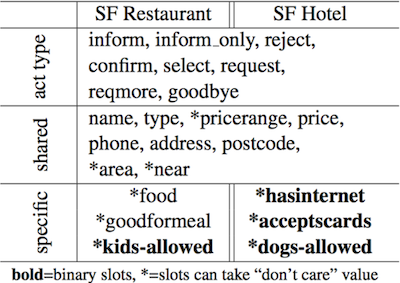
Semantically Conditioned LSTM-based Natural Language Generation for Spoken Dialogue Systems 논문(2015)
구조화된 데이터를 텍스트로 변환하는 task이다.
5.4 Difficulty of Generation
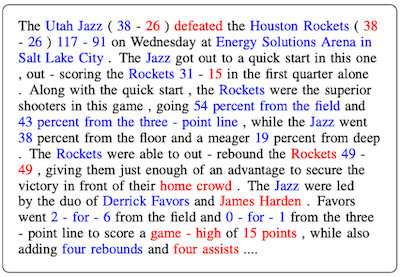
표처럼 structured data를 이해하는 작업은 어려울 수 있다. 다음은 data-to-document generation에서 발생할 수 있는 어려움을 나타내는 예시다.
- data
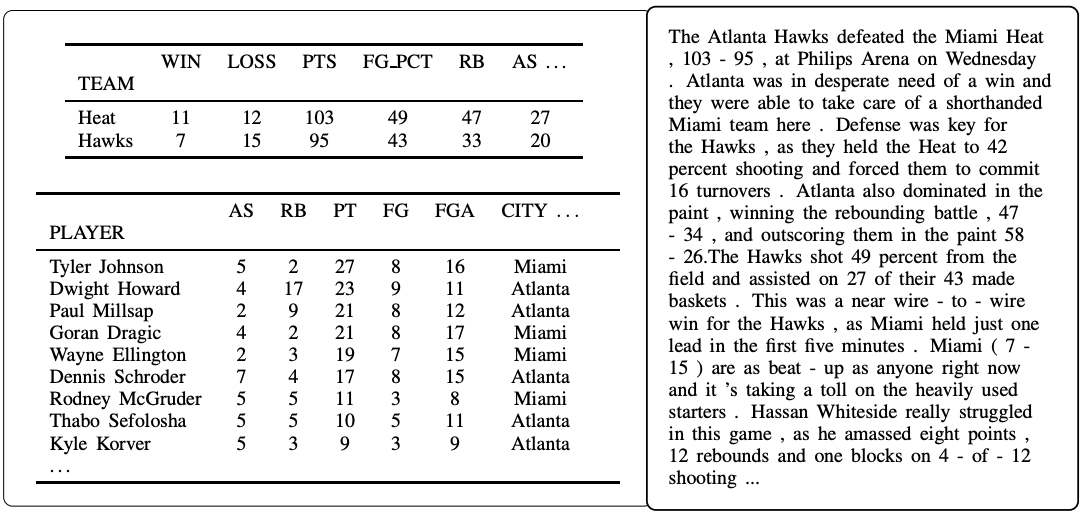
- generated text
다음은 표의 데이터를 기반으로 생성된 텍스트이다.
- 빨간색: erroneous text
5.4.1 Level of Constraint on Output
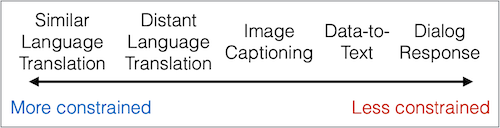
다음은 task에 따른 일반적인 난이도를 비교한 그림이다. 자유도가 높을수록(=flexibility가 높을수록), 대체로 modeling 및 evaluation의 난이도가 늘어난다.
Distant Language: 일본어-영어 등
5.4.2 Controlled Generation
Controlling Politeness in Neural Machine Translation via Side Constraints 논문(2016)
따라서 content에 기반해 자유도를 제안하는 기법들이 사용되고 있다. 다음은 일부 예시이다.
- politeness/style control
입력 와 label indicating style을 함께 전달한다. (e.g. polite, informal)

- personalization
입력 와 speaker의 side information을 함께 전달한다. (e.g. 화자 스타일에 적합한 문장을 생성할 수 있도록)
5.5 Evaluation Paradigm
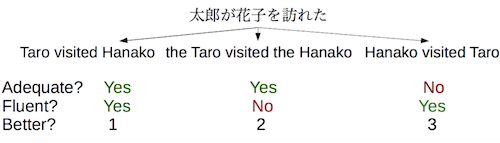
text generation 모델의 evaluation은, 다른 task보다 어려운 편이다.
5.5.1 Human Evaluation
사람의 평가 수준이 evaluation에서 궁극적인 목표에 해당되나, 느리고 비용이 많이 들며, 일관성이 없을 수 있다.
5.5.2 BLEU(Bilingual Evaluation Understudy) Score
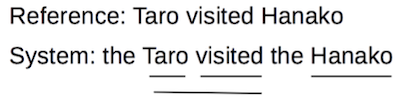
BLEU는 reference를 기반으로, n-gram overlap을 비교하여 점수를 매기는 방법이다.
-
BLEU-2 =
-
1-gram = 3/5
-
2-gram = 1/4
-
brevity penalty = 1.0
brevity = =
하지만 사람의 평가와 일치하지 않는 경우가 많으며, 특히 system의 차이가 클 경우 적합하지 않다.
5.5.3 Embedding-based Metrics
따라서 최근에는 sequence를 encoding한 뒤, 출력과의 similarity를 비교하는 방법이 사용되고 있다.
-
BertScore: BERT embeddings과 similarity를 계산한다. (unsupervised)
-
BLEURT: BERT가 human evaluation scores를 예측하도록 학습한다.
-
COMET: 마찬가지로 human eval을 예측하도록 모델을 학습하나, source sentence도 함께 사용하여 학습한다.
human eval이 불완전할 수 있기 때문에, source를 함께 학습하여 보완한다.
-
PRISM: 시스템 출력이 의역에 해당되는지 여부를 알기 위해, paraphrasing model을 학습한다.
-
BARTScore: 시스템 출력의 확률을 계산한다.
5.5.4 Perplexity
(생략)
5.5.5 Which One to Use?
어떠한 metric을 사용할지는, meta-evaluation 과정을 통해 결정할 수 있다. meta-evaluation이란, human evaluation과 automatic evaluation 사이의, correlation을 측정하는 과정이다.
5.6 Revisiting Search
On NMT Search Errors and Model Errors: Cat Got Your Tongue? 논문(2019)
최적의 성능을 위해서는, 시스템에서 generation에서 사용하는 탐색 알고리즘을 주의해야 한다. 다음은 탐색 알고리즘에 의해 발생하는 대표적인 문제를 나타낸 예시다.
- bad model + big beam
(모델링 오류가 많은) 성능이 나쁜 모델에서 big beam search를 적용할 때, 더 나은 scoring hypothesis는 worse generation을 유발할 수 있다.
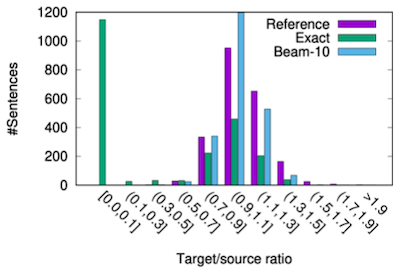
초록색을 최대한 따라갔을 때, 성능이 좋은 시스템에 해당된다.
- argmax 기반의 beam search는, repetition을 유발할 수 있다.

이처럼 좋은 성능으로 알려진 탐색 알고리즘이, 오히려 모델의 성능을 저하시킬 수 있다.
5.6.1 Alternative 1: Worse Search for Better Outputs
먼저 대안으로 lower-scoring hypothesis를 선택하는 방법이 제안되었다.
-
"The capital of Pennsylvania is"
-
다음에 오는 단어의 후보는 다음과 같다.
| word | prob |
|---|---|
| Harrisburg | 34.3% |
| Philadelphia | 31.1% |
| Pittsburgh | 12.9% |
| Easton | 2.2% |
| Lancaster | 1.8% |
| Allentown | 1.6% |
| Washington | 1.5% |
이대 lower-scoring의 구현에서는, 대표적으로 두 가지 알고리즘이 쓰인다. (특히 Nucleus Sampling이 보편적으로 쓰인다.)
| Top-k Sampling | Nucleus Sampling |
|---|---|
| e.g. k = 5(~Lancaster) | e.g. p = 0.8(Pittsburgh) |
5.6.2 Alternative 2: Better Decision Rule
Quality-Aware Decoding for Neural Machine Translation 논문(2022)
또 다른 대안으로 Bayes risk를 최소화하는 방법이 제안되었다.
- Bayes risk
따라서 목표는 다음과 같다.
다음 예시를 보자.

-
beam search, sampling 등의 기법을 통해 n-best list를 획득한다.
-
Bayes risk를 최소화하여, n-best list를 rescoring한다.
5.6.3 Alternative 3: Train Better Model
혹은 bad hypotheses를 고평가하지 않는, 좋은 모델을 학습하는 방법을 고려할 수 있다. 다음은 해당 목표를 달성하기 위해 제안된 대표적인 방법이다.
- Minimum Risk Training
주로 강화 학습, enumeration을 사용한다.
- Margin-based Training
주로 ranking, contrastive learning을 사용한다.